


The livestock feed sector plays a key role in the economy and food supply of millions of people around the world. However, its environmental footprint is significant. Producing animal feed requires large amounts of water, energy and land, often resulting in a significant contribution to greenhouse gas (GHG) emissions.
In addition, Europe imports most of the feed it consumes, meaning that many of these environmental impacts are shifted to other regions of the world. The challenge, therefore, is to transform the livestock feed sector into a climate-neutral food system, reducing its footprint without losing its crucial economic and social role.
The production of meat, milk or eggs involves complex value chains that depend on limited resources and are still largely based on linear, non-circular systems. In recent years, the European Union has begun to support projects aimed at changing these models and promoting more sustainable, local and resilient solutions.

From linear to circular: why feed innovation matters
In this context, NUTRIFEEDS was born with the ambition of transforming animal feed in a truly innovative and disruptive way. The project is structured around three complementary pilot initiatives that allow solutions to be tested, refined and adapted, while learning from real-world conditions.
NUTRIFEEDS focuses on turning waste into valuable food resources and putting these solutions into practice on real farms. Below, we take a closer look at the three pilot projects to better understand what the project aims to achieve and how these ambitions are being translated into action.
Insect upcycling: turning organic waste into protein
The main goal of this pilot is to transform organic waste into animal feed using insects. This first pilot is based on a simple but powerful idea: converting agricultural and food waste into quality feed ingredients.
Large amounts of organic residues are currently discarded or underused, becoming an additional waste management problem. NUTRIFEEDS aims to give these streams a second life by turning them into products with high added value.

The solution relies on black soldier fly larvae, insects with an extraordinary ability to feed on organic waste and transform it into proteins and fats suitable for animal nutrition. The concept is comparable to composting, but instead of producing fertilizer, the larvae generate valuable feed ingredients.
Different types of organic residues will be identified and selected, used as feed for the larvae, and monitored throughout their growth. The resulting ingredients will then be analysed to assess nutritional quality and suitability for livestock feeding under real-world conditions.
This pilot has a dual benefit: reducing waste while creating a local protein source that can replace imported feed ingredients such as soy.
Targeted fermentation: unlocking the full potential of feed ingredients
The second pilot focuses on improving the nutritional, functional and safety profiles of feed ingredients through advanced fermentation and bioprocessing techniques.
Fermentation is already part of everyday life, from bread and yoghurt to cheese and beer. NUTRIFEEDS applies this well-known process to animal feed, where many plant-based ingredients have high nutritional potential but are difficult for animals to digest.
By fermenting these ingredients, undesirable compounds can be reduced while nutrient availability is improved. In this sense, fermentation acts as a form of pre-digestion, making nutrients easier for animals to absorb.
As a result, this pilot aims to deliver more nutritious livestock feed with improved digestibility, longer shelf life, and enhanced preservation, contributing to both animal health and feed efficiency.
From innovation to reality: testing livestock feed solutions on regenerative farms
The third pilot brings the project’s innovations into real farming environments. Feed formulations developed in the first two pilots will be tested on working farms, ensuring that solutions are not only scientifically sound but also practical and economically viable.
This pilot focuses on silvopasture systems, where livestock, trees and pasture coexist. These systems mimic natural ecosystems, promote biodiversity and support soil health.
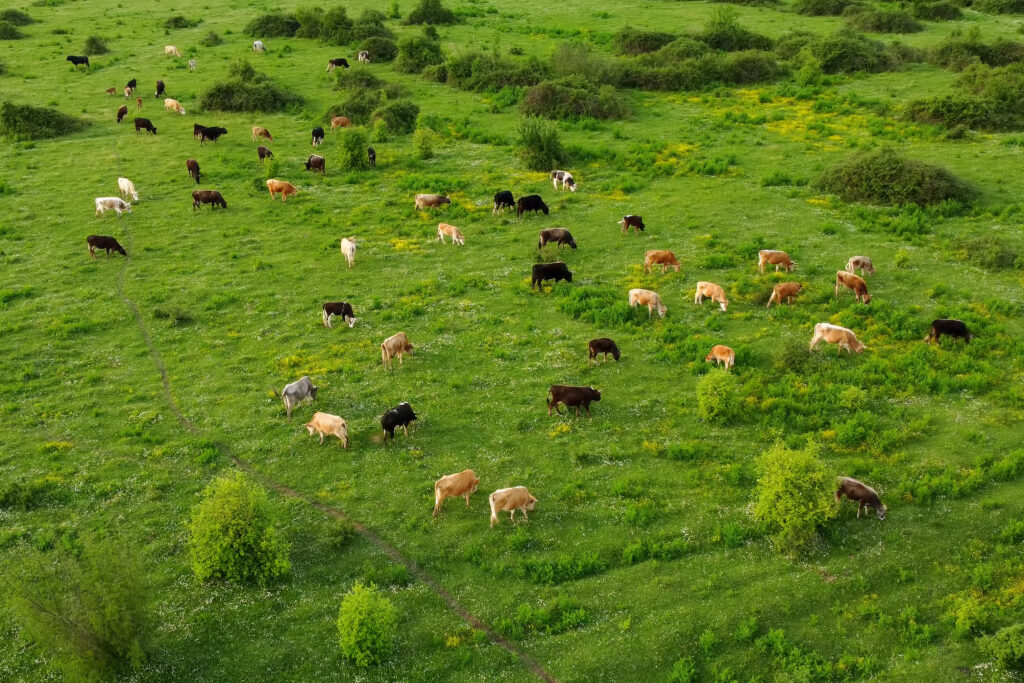
Animals will be fed diets incorporating insect-based and fermented ingredients, while animal health, environmental performance and farm-level feasibility are closely monitored. This step is essential to ensure that sustainable livestock feed solutions work under real European farming conditions.
Three pilots, one vision: a circular future for animal feed
NUTRIFEEDS follows a clear and logical pathway: transforming waste into valuable ingredients, improving the livestock feed quality and preservation, and validating solutions on farms.
Rather than focusing on theoretical approaches, the project delivers practical pathways towards a more sustainable and circular animal feed system. By working closely with farmers, NUTRIFEEDS ensures that innovation is grounded in reality.
The project partners aim to generate replicable knowledge, driven by the conviction that animal-based food production can coexist with efficient resource use, environmental regeneration, and long-term sustainability.